If you’ve had fillings for many years, there’s a good chance at least one is silver-coloured amalgam. For generations, amalgam was the go-to material for repairing cavities, especially in back teeth, durable and effective at preserving damaged teeth for millions of people. Today, though, many patients would rather have a restoration that blends naturally into their smile.
That’s where composite fillings have changed the conversation. These tooth-coloured restorations let us repair decay while closely matching the surrounding enamel. At Elgin Dental Group, patients comparing composite fillings vs. amalgam are usually interested in more than looks. They want to understand what’s being placed in their mouth, whether an old filling should come out, and which option makes sense for their long-term dental health.
Why Composite Fillings Have Become So Popular
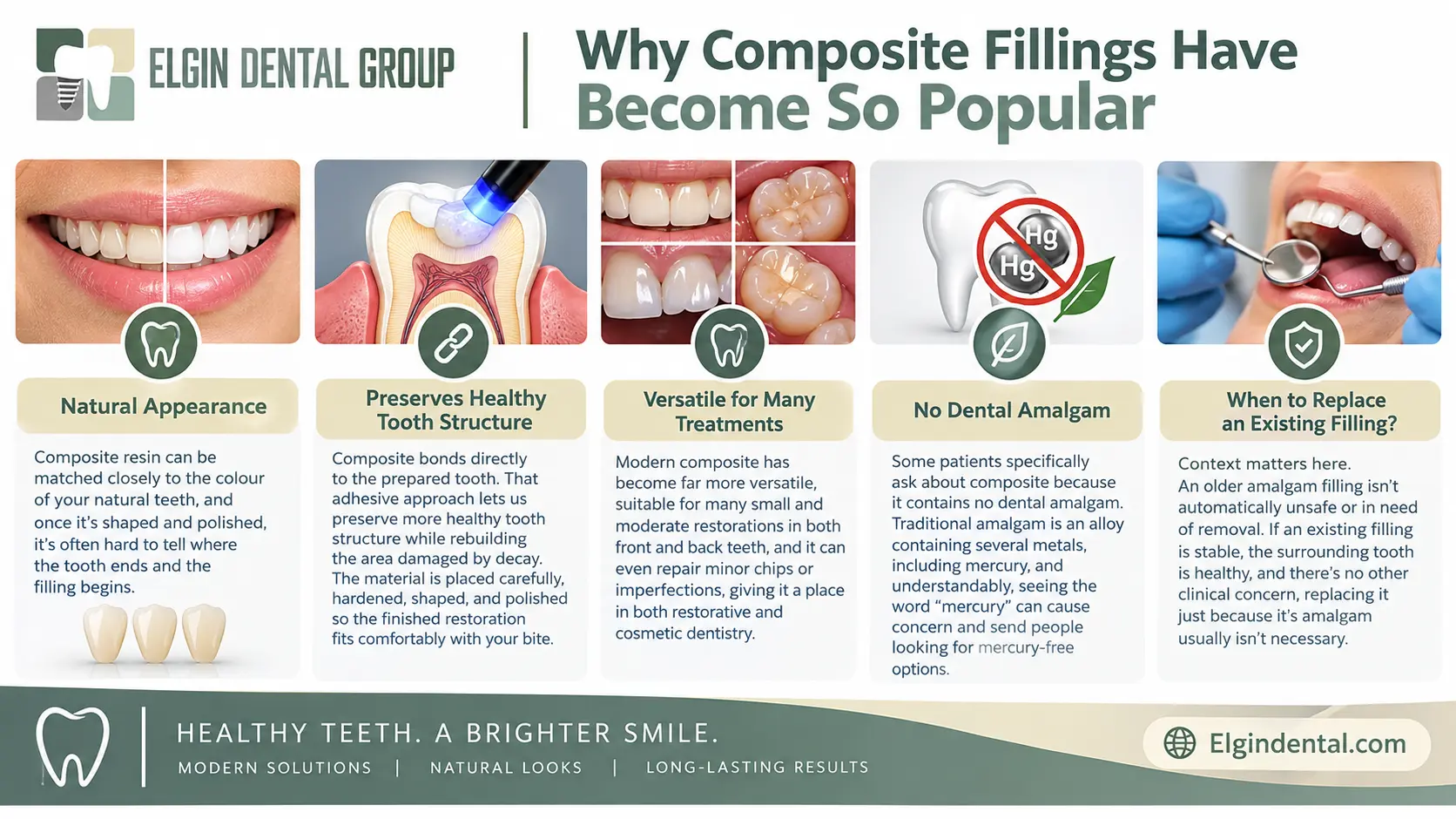
The most obvious advantage is appearance. Composite resin can be matched closely to the colour of your natural teeth, and once it’s shaped and polished, it’s often hard to tell where the tooth ends and the filling begins.
That matters most for fillings visible when you smile or speak, but appearance isn’t the only reason we use composite.
Composite bonds directly to the prepared tooth. That adhesive approach lets us preserve more healthy tooth structure while rebuilding the area damaged by decay. The material is placed carefully, hardened, shaped, and polished so the finished restoration fits comfortably with your bite.
Modern composite has also become far more versatile, suitable for many small and moderate restorations in both front and back teeth, and it can even repair minor chips or imperfections, giving it a place in both restorative and cosmetic dentistry.
Some patients specifically ask about composite because it contains no dental amalgam. Traditional amalgam is an alloy containing several metals, including mercury, and understandably, seeing the word “mercury” can cause concern and send people looking for mercury-free options.
Context matters here. An older amalgam filling isn’t automatically unsafe or in need of removal. If an existing filling is stable, the surrounding tooth is healthy, and there’s no other clinical concern, replacing it just because it’s amalgam usually isn’t necessary.
Should You Replace Your Old Silver Fillings?
Patients sometimes come in expecting that every old amalgam filling should be swapped for composite. We prefer to look at each restoration on its own.
Fillings don’t last forever, regardless of the original material. Years of chewing and temperature changes put real stress on a restoration, and over time a filling can wear down, chip, fracture, or develop problems at its edges. The tooth itself can develop cracks or new decay too.
During an exam, we look closely at the restoration and the tooth around it, and dental imaging can help catch problems that aren’t visible on the surface.
If an older amalgam filling is starting to fail, replacing it with a tooth-coloured composite can be a good opportunity to restore the tooth and improve its appearance at the same time. But if the tooth has lost a significant amount of structure or developed a substantial crack, a composite filling may not offer enough protection, and a different restoration like a crown may be the better call.
That’s why the decision to replace an old filling should start with an exam, not just how it looks.
There can be cosmetic reasons too. Some patients simply don’t like seeing dark or silver fillings when they smile. If appearance is your main concern, we can assess the restorations and walk through the pros and cons of replacing them so you can make an informed choice.
Choosing the Right Restoration for Your Smile
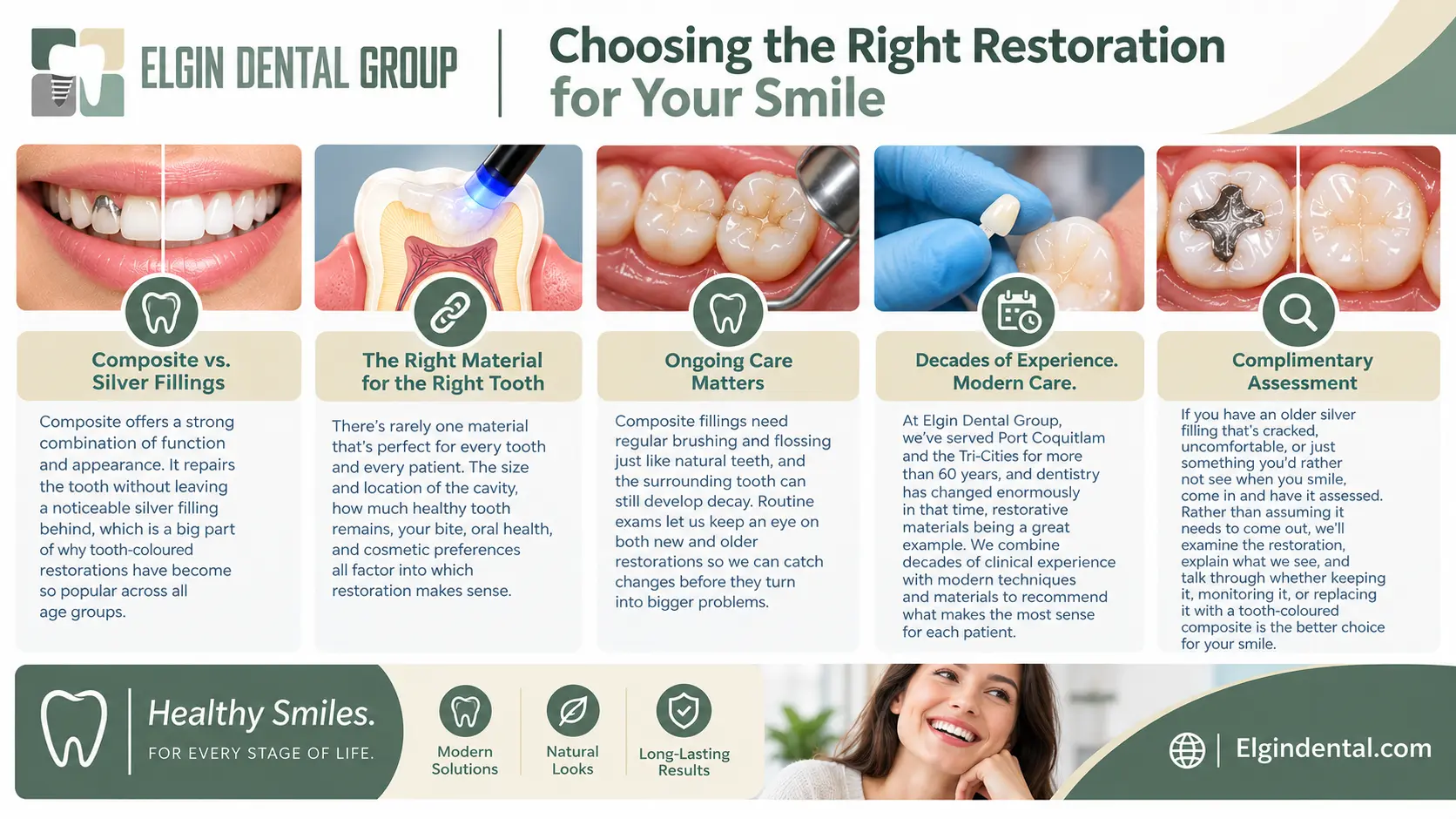
There’s rarely one material that’s perfect for every tooth and every patient. The size and location of the cavity, how much healthy tooth remains, your bite, oral health, and cosmetic preferences all factor into which restoration makes sense.
For a lot of everyday restorations, composite offers a strong combination of function and appearance, letting us repair the tooth without leaving a noticeable silver filling behind, which is a big part of why tooth-coloured restorations have become so popular across all age groups.
Good care after treatment still matters. Composite fillings need regular brushing and flossing just like natural teeth, and the surrounding tooth can still develop decay. Routine dental exams let us keep an eye on both new and older restorations so we can catch changes before they turn into bigger problems.
At Elgin Dental Group, we’ve served Port Coquitlam and the Tri-Cities for more than 60 years, and dentistry has changed enormously in that time, restorative materials being a great example. We combine decades of clinical experience with modern techniques and materials to recommend whatever makes the most sense for each patient.
If you have an older silver filling that’s cracked, uncomfortable, or just something you’d rather not see when you smile, come in and have it assessed. Rather than assuming it needs to come out, we’ll examine the restoration, explain what we see, and talk through whether keeping it, monitoring it, or replacing it with a tooth-coloured composite is the better choice for your smile.
Frequently Asked Questions About Composite and Amalgam Fillings
Are composite fillings better than amalgam fillings?
Composite offers real advantages, particularly its natural appearance and ability to bond to tooth structure. The best restoration still depends on the tooth, the size of the repair, and the individual patient’s needs.
Do old amalgam fillings need to be replaced?
Not automatically. An amalgam filling that’s still functional with no signs of problems can simply be monitored at regular visits. Replacement usually comes up when the restoration is failing or the surrounding tooth develops an issue.
Do composite fillings contain mercury?
No. Composite fillings are made from tooth-coloured resin-based materials and don’t contain the mercury found in dental amalgam.
Can you replace my silver fillings with white ones?
In many cases, yes. We first need to examine the tooth to see how much healthy structure remains and whether composite is the right option.
How long do composite fillings last?
There’s no guaranteed lifespan. It depends on factors like the filling’s size and location, chewing forces, oral hygiene, diet, and whether you clench or grind your teeth. Regular exams help us track restorations over time.
How do I know if an old filling is failing?
You might notice sensitivity, pain when biting, a rough or broken area, or part of the filling coming loose, though failing restorations don’t always cause symptoms. Regular exams help catch deterioration, cracks, or decay before you’d otherwise notice.